

from Crucifixion to Gothic statement: The Evolution of the Cross in Fashion
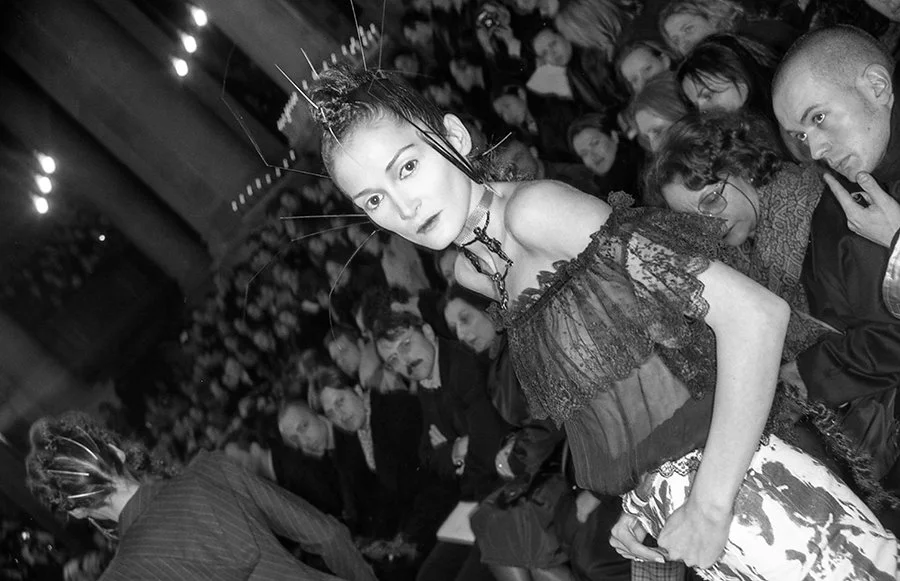
Plum Sykes walks Alexander McQueen A/W1996 runway, donning crucifixion jewelry, Victorian-inspired black lace, and bleach-splattered denim with spikes– representing an intersection of goth, punk, and renaissance. Photo Courtesy of Civilian Global.
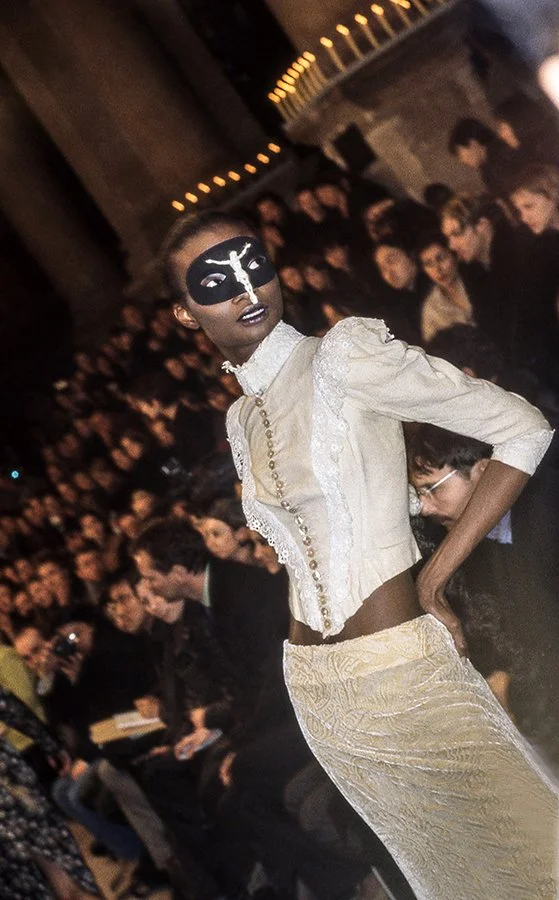
Joel-Peter Witkin, a photographer and close friend of McQueen, was inspired by the crucifix masquerade; Witkin is famous for his nightmarish imagery created using cadavers. Photo Courtesy of Civilian Global.
Set against a golden church in East London, a long black silhouette emerges, its face obscured by a crucifix mask. This mask would end up being one of the most controversial in fashion history. In 1996, Alexander McQueen unveiled his Autumn/Winter collection, Dante, staging a provocative yet haunting scene. Dante set to encapsulate themes of religion, war, and institutional power, weaving them into Victorian and Gothic-inspired designs.
“I think religion has caused every war in the world, which is why I showed it in a church,” said the designer in an interview.
Little did McQueen know that this collection would secure his place in fashion history, while simultaneously positioning him at the center of controversial crossroads. When designing the collection, he aimed to demonstrate the role of institutional powers, like religion, in war settings. When Dante debuted in 1996, many critics condemned the crucifix imagery as profane— especially in a church setting. While some viewed his collection as disrespectful or sensationalist, others praised it as a visionary challenge to fashion’s complacency.
There are very few symbols as widely recognized as the cross. Derived from ancient pagan traditions and later an instrument of Roman crucifixion, it has since evolved into one of the most pervasive symbols in contemporary culture, regardless of religious connotation. Mainstream fashion trends are reproduced on everything from t-shirts to accessories. Modern goths fled to Hot Topic, bearing crosses head to toe. Goth counterculture in particular chose to embrace the cross, embedding the symbol into everyday dress.

Artist Rosalía wearing Alexander McQueen's S/S23 Rosary heels in her music video for “Berghain” proves Alexander McQueen’s chokehold on Gothic fashion to this day. Photo Courtesy of British Vogue.
So, does the cross still belong to religious iconography, or has it evolved into a broader form of artistic expression?
Once a symbol of punishment and later religious authority, the cross has been reinterpreted within subcultures and mainstream media as both an aesthetic and a political statement. Many artists, including Leon Ferrari to Andres Serrano, believe the cross as a source of inspiration rather than a source of shame or theology. While opinions surrounding the religious irony in art have resulted in immense controversy, it also acts as a means of reunification in response to the church’s injustices.
Situating The Cross
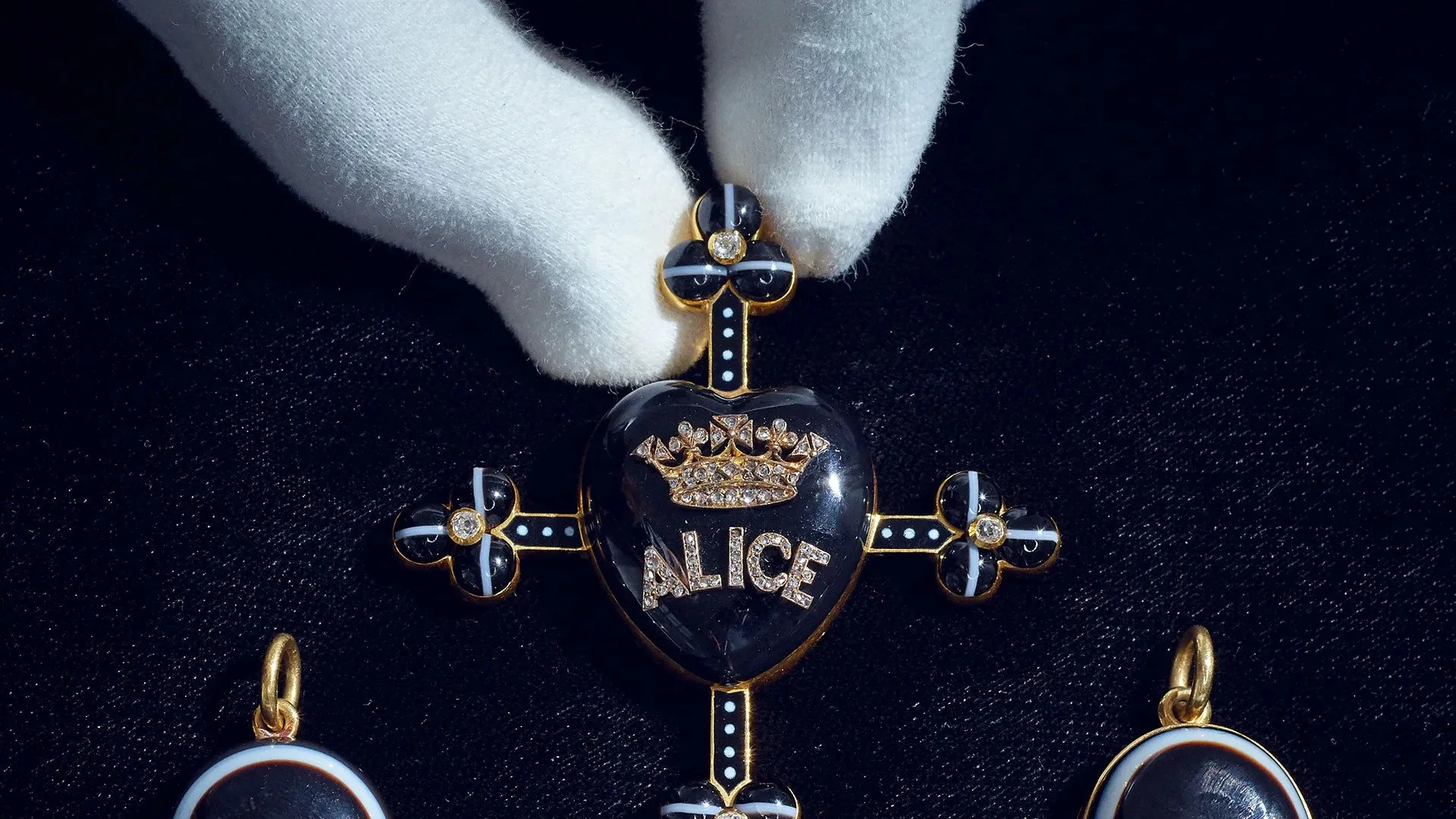
Queen Victoria’s famous black cross ‘mourning jewels’ were worn during her 40 years of grieving her late husband and other family members. Photo courtesy of Sotheby’s.
The cross: one of the most universal and widely influential symbols known to man. This emblem has been the universal symbol of Christian faith for more than two millennia, taking every form and size across the world. But the cross first appeared much earlier than that, with it being found in Jerusalem excavations of Stone Age settlements and Pagan ritualistic cultures. It has been used for sacrifice rituals, decoration in houses and places of worship, coins and currency, and, of course, a motif for jewelry.
In Orthodox cultures, the cross is something intimate—for personal view, representing the intimate relationship with God. Only priests were allowed to wear it outside their clothes. However, over time, crosses became more intricate and luxurious, wherein more people started wearing them as a dedication to religious faith. Thus, the ornamental cross was born.
During the Renaissance, the cross became a profound symbol of faith, often heavily adorned with precious stones and lacework to represent both piety and high social status, bridging spiritual life with luxury. By the 19th Century, elites like Queen Victoria donned intricate bejeweled crosses and royal heirlooms. She would even popularize the use of jet black crosses as a means of religious devotions, especially when mourning. Though the frequent wearing of the cross in elites might be seen as an attempt to solidify their divine right to rule, according to some historians.
Counterculture and Reclaiming
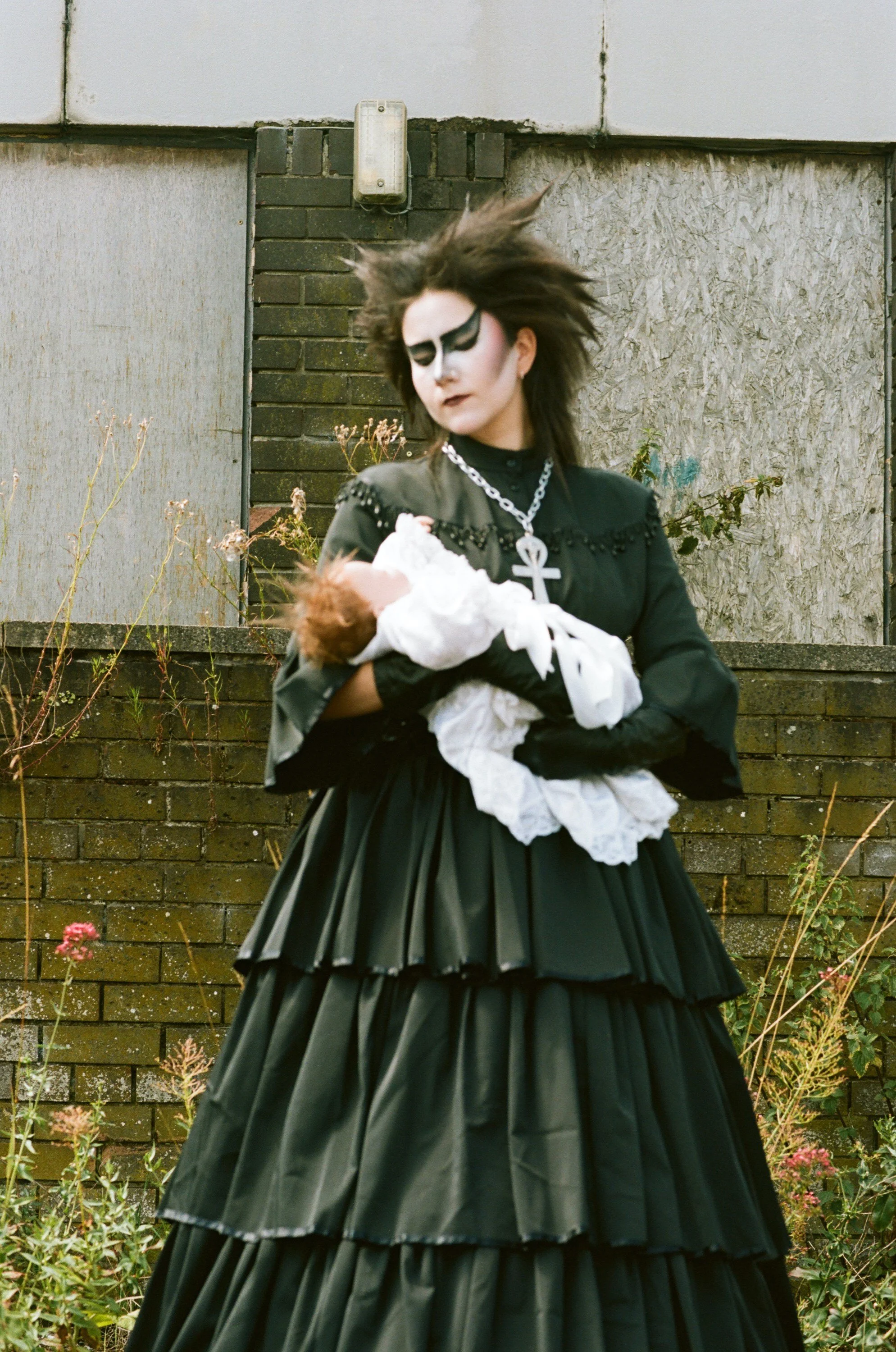
Photographer Xanthe Hutchinson and stylist Helen McGuckin capture and survey British communities in England. Photo Courtesy of Dazed Magazine.
While the cross once symbolized tradition and piety, through centuries of evolution, the cross was reborn as a symbol of individualism. Subcultures, like the goths, punks, and hippies, bore crosses as means of recontextualization. Counterculture aimed to reclaim it from the oppressive institutions it once symbolized, and the same institutions shunned these communities.
Goth in particular originally evolved from the punk movement, replacing high-energy aggression with a fascination with melancholic, romantic, and macabre aesthetics, heavily inspired by horror, Gothic literature, and vampire lore. Although associated with misfits donning all-black outfits and misconstrued with emo and punk aesthetics, it is defined by its alternativeness. The subculture finds “beauty in things others might consider dark,” romanticizing the unexpected. Whether that's a feeling of existential teenage dread, an appreciation for neo-classical Gothic art, or reclaiming an age-old Gothic symbol, like the cross. Rather than reflecting piety, it evokes the gloom and mourning of religion.
While the subculture didn’t protest the religion in a physical sense compared to other subculture movements, the intention of the imagery symbolized a societal shift. A shift towards acceptance of melancholy and mortality as a means of individual strength. During the 20th-century post-Cold War era, which emphasized complacency and often religious authority, aesthetic reclamation acted as a form of "semiotic guerrilla warfare." The passive objective was to move the symbol from the domain of institutional authority to individual expression.
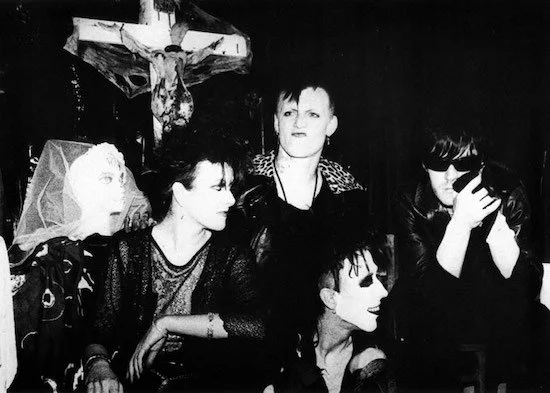
In the early 1990s, British youth flocked to The Batcave, an infamous nightclub said to be the ‘Goth Garden of Eden’ or the founding place of goth culture, where even the social recluse could enjoy gigs and Gothic fantasies without judgment. Photo Courtesy of The Quietus.
Other counterculture movements, like the punk or hippie movements, did sometimes use the irony of the cross as political statements. Sometimes the cross would shock, often wearing it invertingly or pairing it with subversive attire to challenge authority. Some goths, particularly those with traumatic religious upbringings, wear the symbol to reclaim it from systems they consider oppressive. Similarly, designers like Versace and Dolce & Gabbana have used the cross as a dramatic accessory, blending it with luxury to symbolize Byzantine or Italian Catholic opulence rather than personal piety.
Alexander McQueen, in particular, was famous for frequently adopting a “goth” style, drawing inspiration from the Gothic and Victorian eras. We see in his collections the consistent use of dark colors, lace, dated or weighted iconography, and most importantly, melancholic themes. Although Gothic subculture is not inherently politically based, McQueen relied on his collections to make a political statement; in this case, he wanted to protest institutions like the church.
The cross no longer belongs to a single meaning—it exists in a constant state of reinvention, shaped as much by rebellion and aesthetics as by faith. What was once an instrument of suffering has become a symbol worn, contested, and redefined, revealing as much about power and identity as it does about belief.