

Holi, Felt
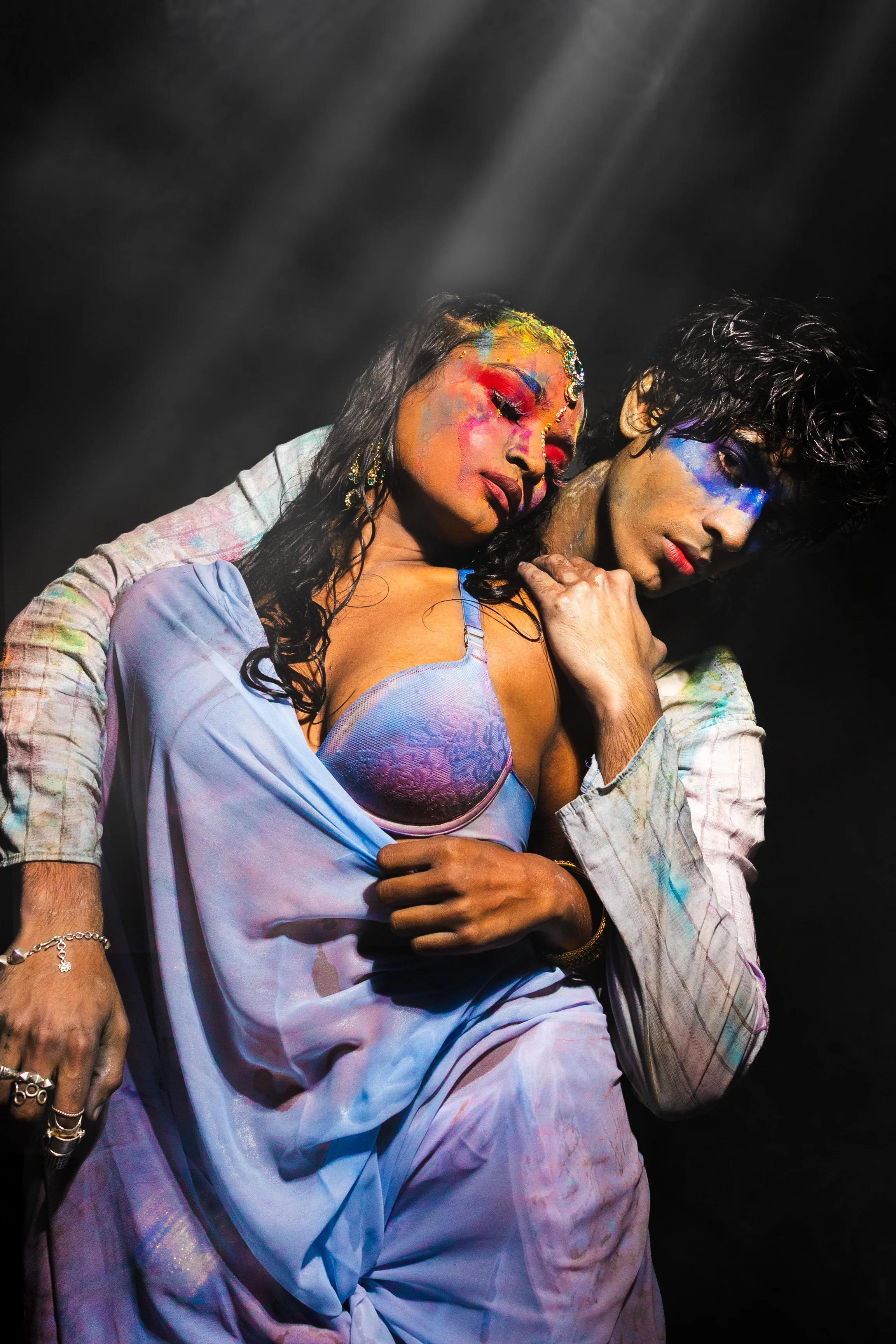
Original photoshoot by FAST at UCLA. Photography by Rajveer Batra and Siena Hunt. Modeling by Neha Gundubogula and Ruhaan Mahindru. Hair and makeup by Adebanke Osibamiro Sedun and Godwina Ogbeide. Production by Alice Stessman, Jae Ou, and Gretchen Reyes.
Winter has a way of teaching the body restraint. It asks us to live in muted tones and carry our longings inward. Then, at the cusp of spring, Holi arrives as an astonishment of color, touch, memory, and release. With clouds of pink, blue, and saffron rising against the last pallor of winter, our skin stains with the hues of an age-old tradition until the body remembers the lushness of being alive.
THE FESTIVAL AT THE CUSP OF SPRING
Holi, often known as the Hindu festival of colors, is one of South Asia’s most beloved heralds of spring. Arriving in the month of Phalguna (the twelfth month of the Hindu calendar, associated with late winter and early spring) with all the fervor of renewal, devotion, play, mischief, and communal warmth. Across regions, households, and diasporic memory, this festival remains unswerving in spirit and incomparable to any other celebration. It blooms in the fire of Holika Dahan (the ritualistic bonfire lit on the eve of Holi, symbolizing the triumph of good over evil), rises with the morning air grown thick with gulal (colored powder), and spills into the dancing waters of a pichkari (water gun). It is a festival replete with the laughter of kin and companions, the music, the mithai (traditional sweets), and that fleeting hour in which boundaries, formalities, and distance between strangers dissipate, leaving every face dusted as bright as the season’s first blossoms.
A PERSONAL VANTAGE
For some, Holi is tethered closely to mythology and ritual; for others, it is inseparable from family, food, laughter, music, flirtation, and the delicious disorder of community. It has been associated with the triumph of good over evil, with the arrival of spring after winter’s inertia, and the beloved leela (divine play) of Radha and Krishna, through which color signifies adornment and unity. And yet, no singular article can claim the entirety of such a festival, whose meanings are carried differently across lineage and remembrance.
Holi, Felt is not Holi as monolith, nor Holi as ethnographic summary, but Neha Anushka personal interpretation of Holi, as shaped through her FAST shoot, Holi, Felt. This article offers a singular vantage of Neha’s Holi, braided from childhood memory, mixed inheritance, aesthetic instinct, and her ardor.
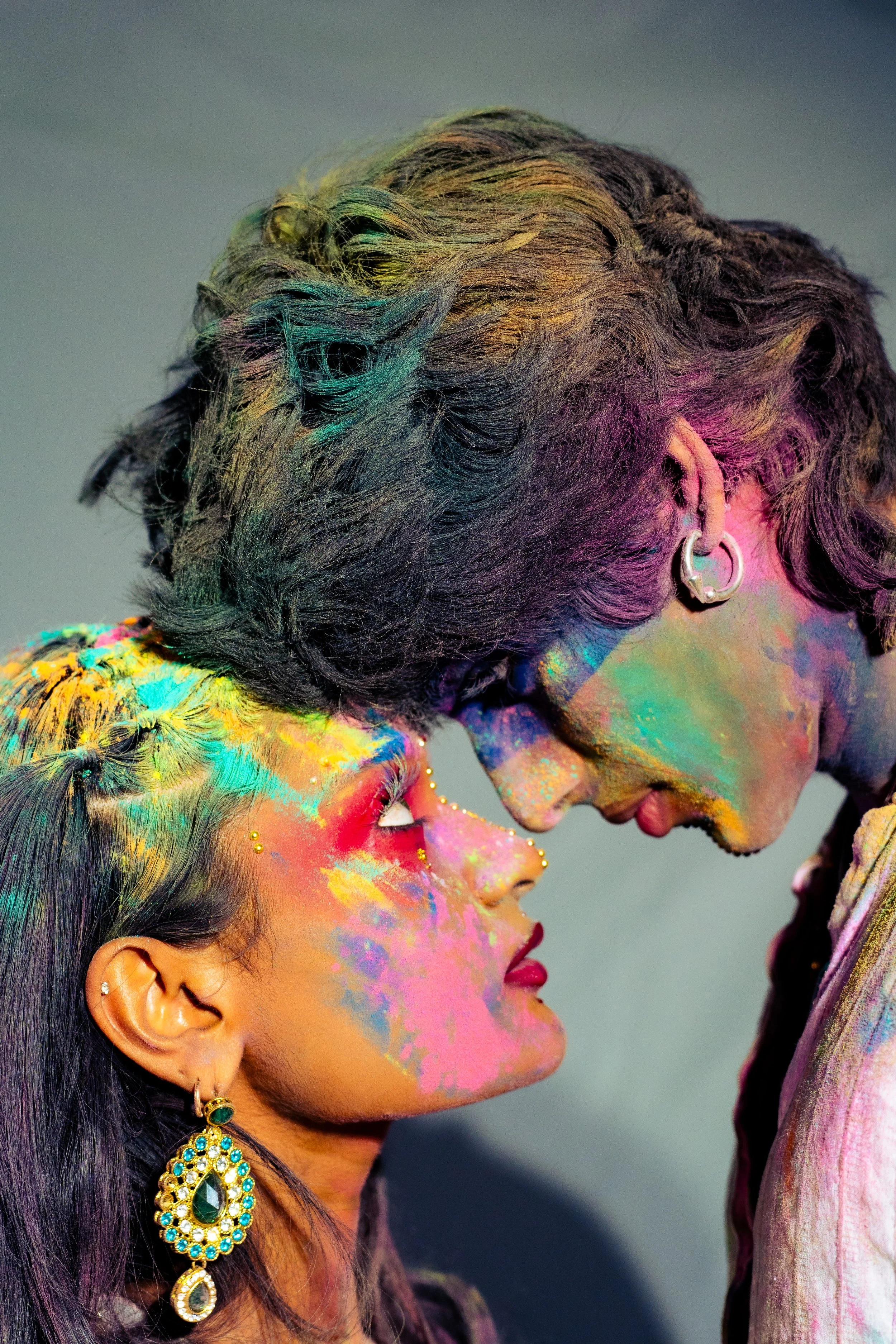
From the beginning, Neha spoke of Holi with the vehemence that only intimate familiarity can inspire. She said, “Every time spring came, I was always so excited for Holi. And it's one of my favorite memories of my childhood. It wasn't just tradition, it was one of the moments where we all came together in pure joy and celebration.” There is a sincerity in the way she says this that cannot be feigned. Holi, for her, is not first an event but a sensation of belonging and a yearly aperture through which frivolity and kindred spirits awaken.
Growing up in Texas, around a large Indian community, Neha came to know Holi as a festival of convergence, where family and friends, temple grounds and balmy days, white shirts and stained skin, all seemed to gather for a celebration suffused with childish play and sonorous laughter. Her first memory of Holi lives in the bright, ordinary details like finding friends among people she had not known before and brazenly throwing color at strangers with the greeness and innocence of someone too young to fear embarrassment. “It was a whole experience,” she recalled. “It might sound super simple and mundane, but it’s honestly something that I truly love.” Even the aftermath sits sweet in her memory: the body coated with layers of pigment, the stubborn sillage of colorant refusing to wash away even after incessant scrubbing and the hour-long shower ritual, and the drive home in clothes still marked by the day, and the feeling that Holi, once it touches the heart, is never in any hurry to leave.
BEYOND THE IMAGE
What Neha wanted to capture in Holi, Felt was not simply the visual language of Holi, but the emotional and tactile life beneath it. She was not interested in reducing the festival to a photogenic burst of pigment, nor in offering color as something to be passively admired from afar, but in reaching toward the charge that animates it: the texture of nearness, the warmth of touch, and the social permissiveness of a day through which formality gives way to kinship. “I really wanted to represent how Holi is not just the festival of colors, but also a festival of love, intimacy, and connection,” she said. It was here that intimacy crystallized into the axis of the shoot and its central claim.
Too often, Holi is aestheticized from the outside in, as color is severed from context and powder becomes picturesque before it becomes meaningful. Yet, for Neha, color is the medium through which nearness is made visible, the means by which the body becomes a site of exchange: a hand to the cheek, pigment to the collarbone, laughter to the shoulder, stranger to accomplice. “The feeling of Holi is honestly more important to me than the visual aesthetics,” she said. “There is the feeling of the powder, the feeling of being around everyone. All of it points to one emotion.” The intelligence of her vision lies there, in her insistence that feeling precedes image.
Since her own upbringing was, in her words, “a mixed bag,” she remains especially attentive to the layered ways in which culture is carried. “I’m not fully Indian. I’m half Sri Lankan and half South Indian,” she explained. “My dad is Hindu, and my mom is Catholic, so growing up there was so much that I learned and absorbed.” This multiplicity does not thin her relationship to Holi. If anything, it enriches it. She speaks of the festival through the stories and sacred associations that surround it, invoking the lore of Holika, the triumph of good over evil, and the beloved story of Krishna and Radha, where Krishna’s insecurity over his dark complexion and Radha’s fair skin blossoms into an entire poetics of color.
In Neha’s imagination, these stories are not inert fragments of mythology preserved merely for citation, but part of the emotional climate through which Holi is felt. She brings to light that Holi is not only seasonal in its arrival but also psychic, marking the easing of heaviness, the return of warmth, and the shedding of what the self can no longer inhabit, "Holi is about release, letting go of your past grievances... the version of you that you've outgrown and just allowing yourself to discover a new version of self." she said.
That sentiment acquired a deeper poignancy in our first conversation, because she spoke with utter sincerity about grief, loss, and the heaviness that had shadowed the months preceding the shoot. “The timing of this shoot felt divine. I went through one of the hardest winters; pain, endings, change, all of it. Getting to channel all of that into something that celebrates renewal and rebirth, felt like paying homage to what the holiday is supposed to celebrate. That's what I needed." she said. What emerges in that confession is something larger than styling or editorial ambition: a transmutation of grief into Krishna blue, of silence into yellow light, of heaviness into green beginnings, and of ego into the red of fire.
THE ETHICAL CALCULATION
Throughout the making of the shoot, Neha wrestled with a question that shadows any culturally rooted artistic work: how does one honor inheritance without becoming timid before it? In the early stages, she was deeply conscious of cultural accuracy and wary that the very qualities that gave the shoot its voltage, intimacy, and interpretive freedom might also leave it vulnerable to misunderstanding. Yet over time, that apprehension gave way to trust. In our post-shoot interview, she named that shift with clarity: “I was constantly worried about the cultural accuracy of the shoot. We conceptualized it together, and I remember asking Sanya again and again what would read and what would not. But through that, I evolved. The more I sat with it, the more I began to trust myself. I have lived this culture. I am a product of its ancestry and history, and I needed to trust that I had the intuition to know what would look right and what would represent us in the best way.”
Part of what emboldened her was seeing South Asian aesthetics already welcomed within FAST’s community with seriousness and emotional depth. As Modeling Director, this shoot became Neha’s own beautiful and vulnerable contribution to FAST’s visual archive. Part of what made this contribution especially meaningful to Neha was her larger hope for what FAST might become. Before graduating, she wants it to feel like a space where people who look like her can recognize themselves without hesitation, and where South Asian students might feel welcomed within the image and community. She named The Saree Effect as a source of encouragement, “I definitely drew inspiration from you,” she said. “If not for that shoot, I do not think I would have felt as comfortable just doing my own thing.” What synergized between the two cultural works was an undergirding realization that personal narration can remain reverent and vital while still carrying formal authority and cultural responsibility.
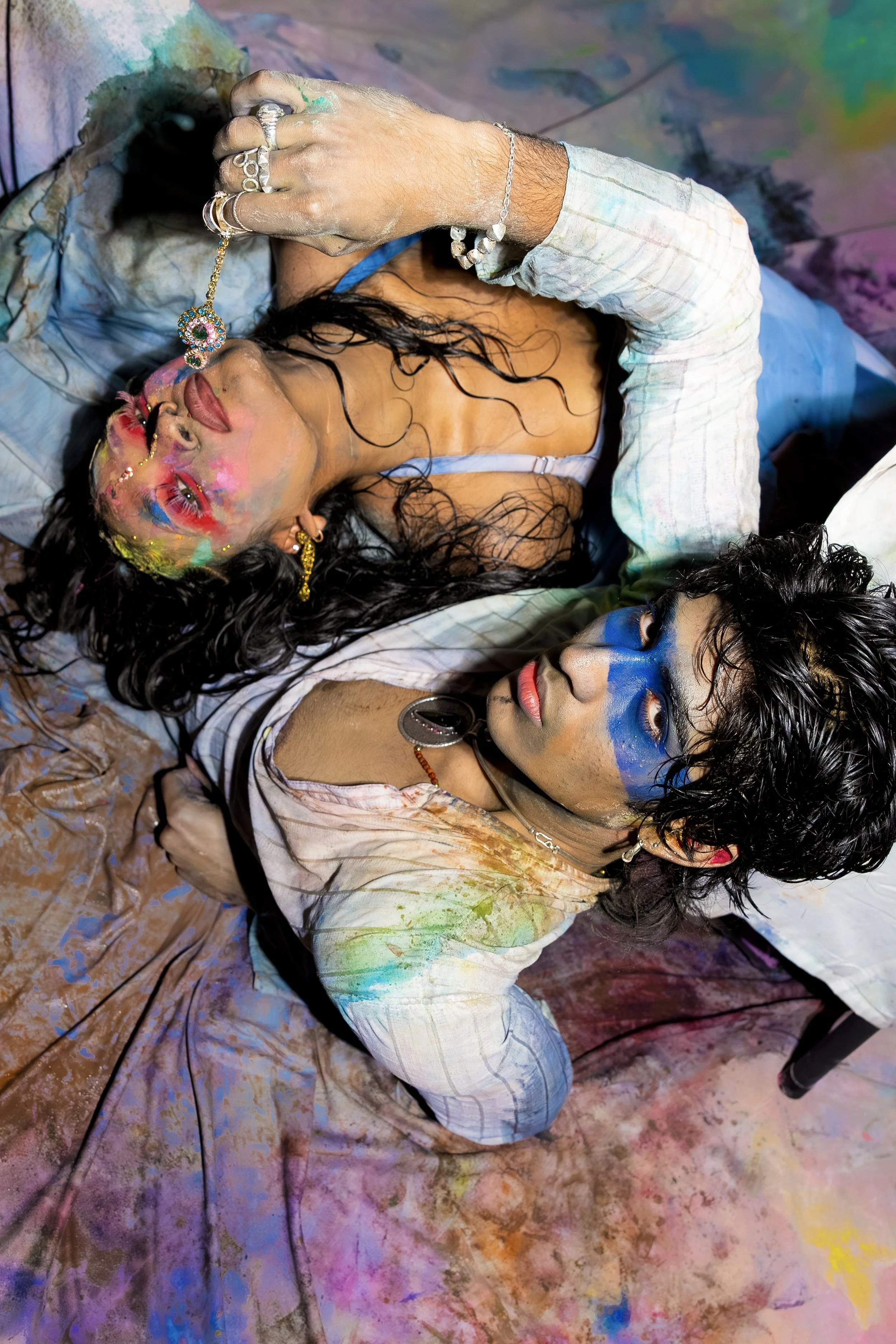
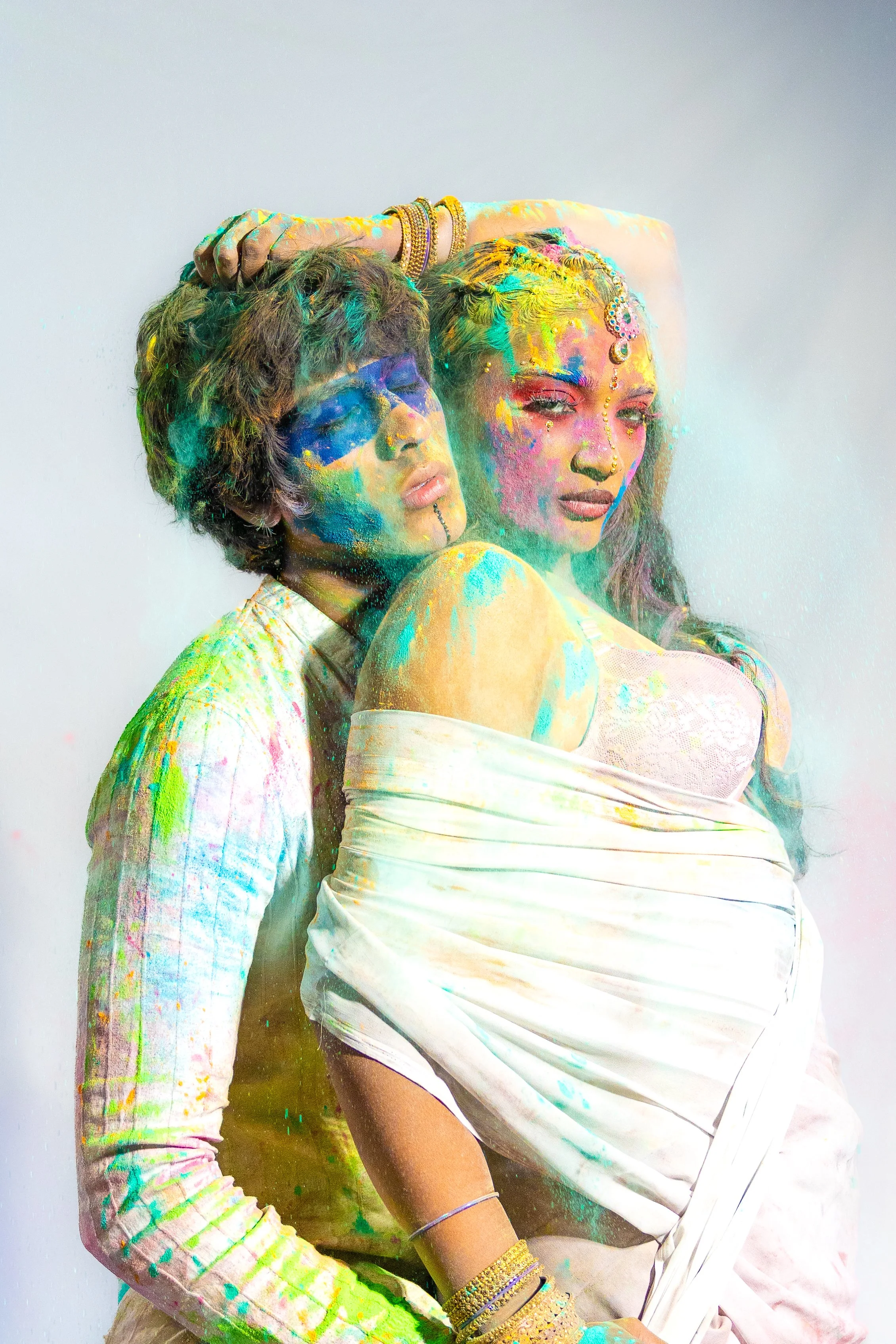
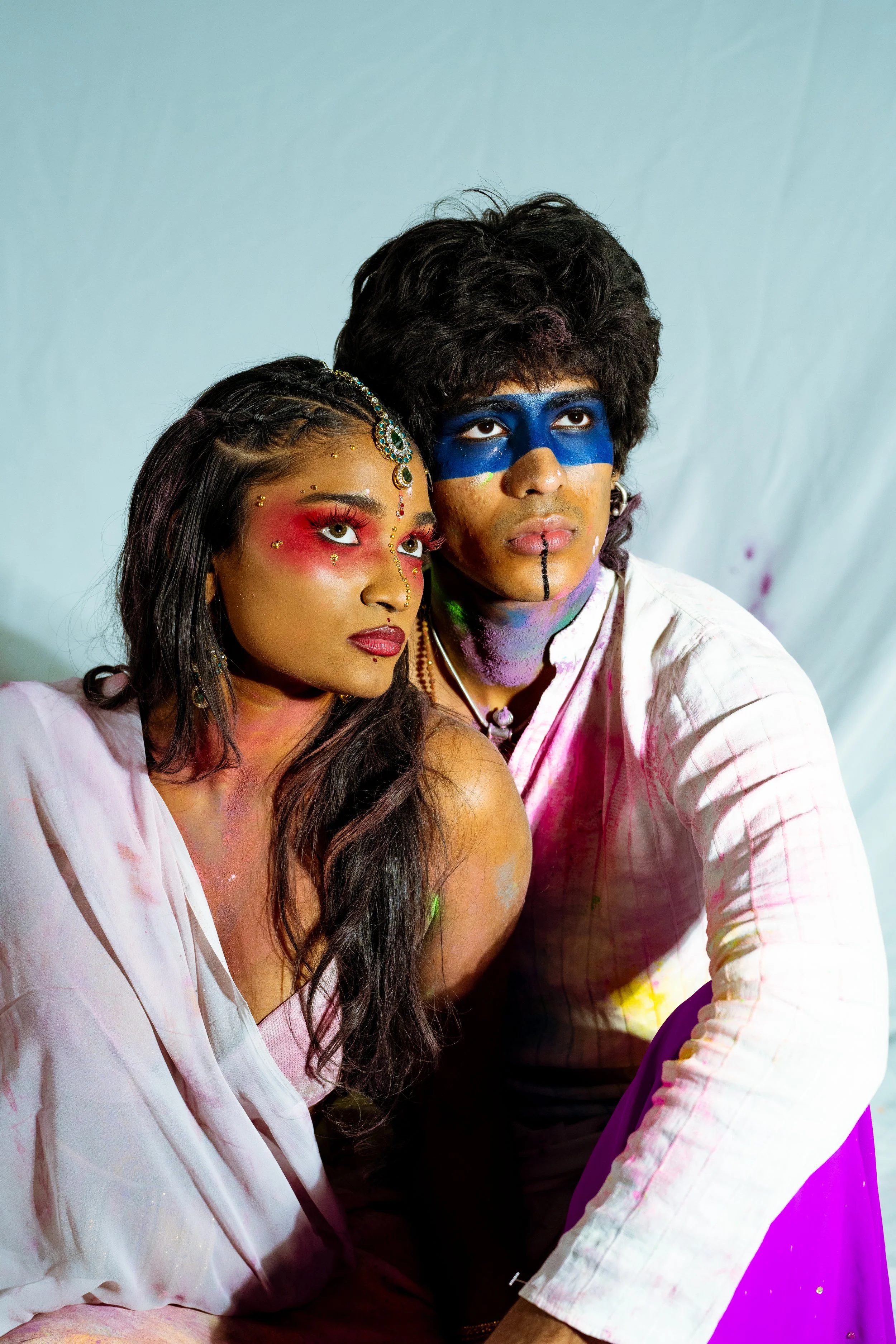
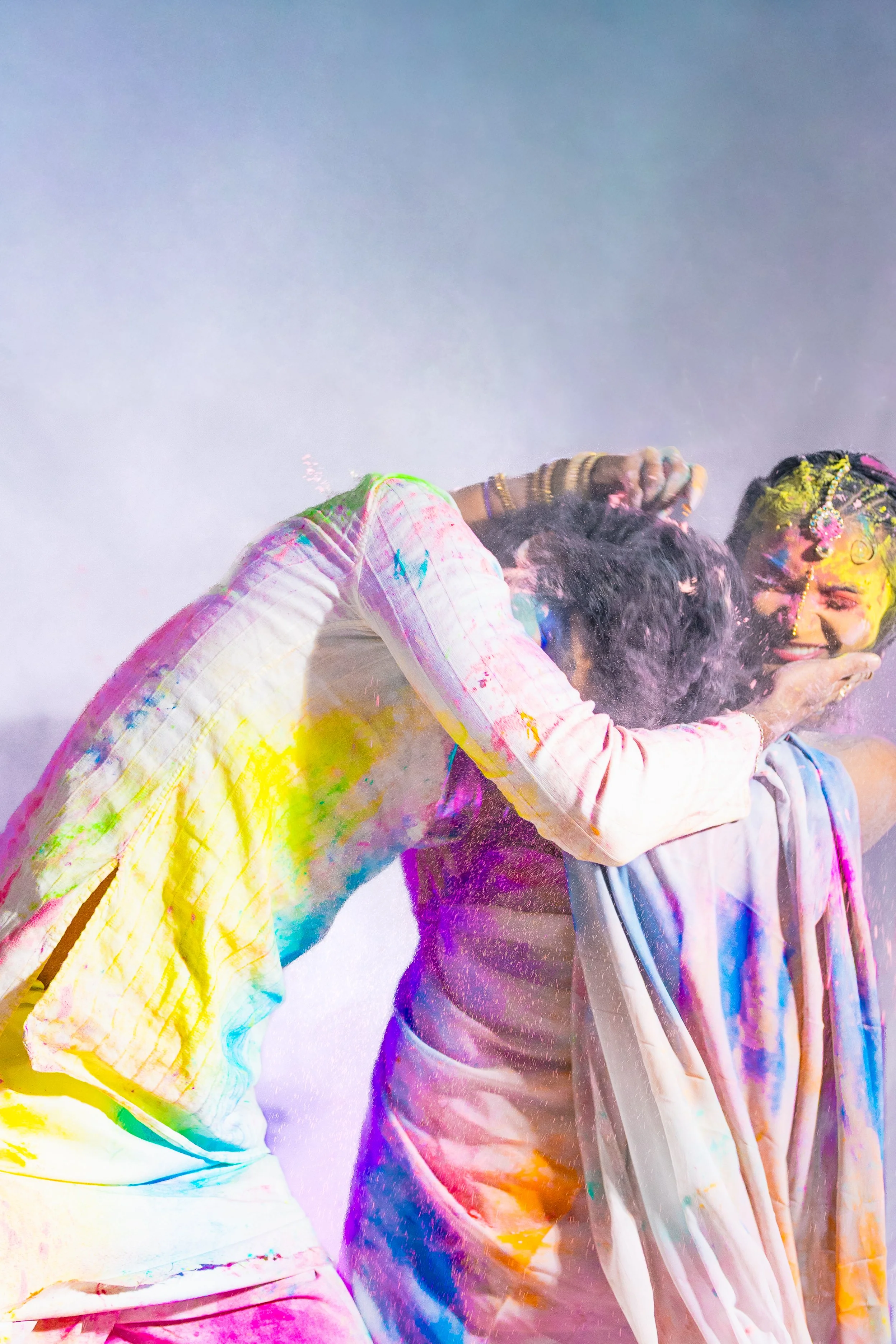
Neha envisioned the shoot as a deliberate progression into Holi’s chaos. She did not want the images to begin at the point of total saturation, where bodies are already drenched in pigment, because that would have bypassed the nascent relationship she wanted to make visible. Instead, she imagined the opening frames with two figures poised and polished, still standing at a slight remove from one another. From there, the distance would begin to thin as powder would travel from cheek to forehead, from neck to shoulder, until what began as pose yielded to impishness and fluidity, and what began as formality dissolved into something more unguarded. As she put it, “They start more posed, prim, proper. They’re looking editorial. They’re taking pictures. They’re just in their own world. And then it kind of comes to a place where they start looking at each other… and then slowly it gets more rugged.” The intimacy of the shoot was not imposed upon the festival from outside, but drawn from Holi’s culture of nearness, where strangers may approach one another with a boldness that would feel improbable on any ordinary day. “You’re going up to people, strangers, literally throwing shit in their face and running away,” she said. “This is an intimate holiday. To do this shoot and not showcase intimacy would not be doing it justice whatsoever.”
THE CONCEPT IN MATERIAL FORM
What unfolded on set exceeded even Neha’s original storyboard. “Before the shoot started, I didn’t realize how much physical touch and intimacy it would hold,” she reflected. “At first, I thought it would be more posed. I didn’t expect so much natural movement. I thought we would be placing the colors very specifically, but the whole thing was fluid. It felt easier to move and be candid than to think in poses.” Strategy yielded to instinct, and the body began to dictate the frame’s logic. “I could not have planned for how the shoot went,” she said, “because when you’re working so intimately, you have to let it flow.” In this manner, the pre-shoot conversation preserved her intention, and the post-shoot conversation revealed how that intention changed once it had passed through the body.
The styling choices bear that reverence as white garments were essential because Holi renders us a blank canvas in anticipation of colours. “I went with all white because I wanted to preserve the integrity of the holiday in some actual way,” she said. “Of course, a lot of it is reinterpreted through my own vision, but that was one thing I really wanted to keep.” Her original mood board leaned more ornate, but she pared the styling back to tika and earrings so the body could remain legible beneath the concept. “If it had been everything, it would not have let the color shine,” she said. Even the backdrop’s austerity was deliberate. By keeping the setting indoors and visually restrained, she allowed the interaction itself to radiate without distraction.
Neha also wanted to press against the conservative habits that often shape cultural shoots, not to scandalize, but to show that tradition can withstand sensuality, freshness, and experimentation. “There was a lot more intimacy and sensuality than someone would naturally expect,” she said. “But I think that’s beautiful, because a lot of the time cultural shoots are done more conservatively. I wanted to challenge that expectation and show that cultural reverence and sensuality aren't opposites.”
Still, the shoot’s deepest current is not rebellion, but longing. “Holi made me feel like I was part of something bigger than myself,” Neha said. It became a way of locating the self within a tradition both inherited and continually refelt. “The whole shoot is about the journey of finding play… finding laughter and freedom and this sense of transformation.” Through its making, Neha moved caution to authorship and self-doubt to instinct to stage an intimate understanding of what the festival has meant within the paradigms of her life and what her upbringing could crystallise into art. What reverberates after the chromatic splendor of the shoot is the privilege of being welcomed into Neha’s intimate and ancestral world, one she shapes with candor and virtuosity.